


Top 200 Drugs Simplified: Pharmacology Coloring Book & Study Guide
Top 200 Drugs Simplified: Pharmacology Coloring Book & Study Guide
Couldn't load pickup availability

Top 200 Drugs Simplified: Pharmacology Coloring Book & Study Guide

"I had highlighted my pharm textbook into a rainbow and still couldn't tell Benztropine from Bupropion. The minute I saw a 'BENZ' car parked next to a 'PARKIN' sign in this book, it locked in for life. I haven't forgotten a single drug I've colored."
The 10-Minute Study Loop That Actually Sticks
The 10-Minute Study Loop That Actually Sticks
Forget rewriting flashcards at 2 a.m. Open the book, pick a drug, color the mnemonic scene while you read the mechanism, and let the image do the heavy lifting. Your brain remembers a dragon in a Cogentin shirt for months, it forgets a wall of black text by lunch. This is the study session that fits between rotations, lectures, and your last cup of coffee.
Why This Book Rewires How You Learn Pharmacology
Why This Book Rewires How You Learn Pharmacology
Break the "Generic Name Wall"
Every drug here leads with its generic name, the one you'll see on the NCLEX, NAPLEX, PTCB, and USMLE and ties it to a brand visual you can't unsee. No more confusing Losartan with Lorazepam at 3 a.m. the night before an exam.
Mechanisms That Move From Page to Memory
Each drug page walks you through the mechanism of action, then drops a "Simplified" arrow diagram below it. You get the scientific version and the version your brain will actually pull up during a patient case.
See the Whole System, Not Just the Pill
Built-in High-Yield Review spreads zoom out to the big picture the Clotting Cascade, the RAAS pathway, Inhaled Agents for asthma and COPD, so you understand why each drug acts the way it does, not just what it does.
Active Learning > Passive Reading
Coloring is a covert study tool. It slows you down just enough to encode side effects, warnings, and contraindications without you realizing you're studying. By the time the page is filled in, the drug is filed away.
Shipping & Processing
Shipping & Processing
Fast Processing: All orders are packed and shipped within 24 hours (Monday–Friday).
Reliable Delivery: Expect your package to arrive in 5–9 business days on average, depending on your location.
Tracking Included: As soon as your order ships, you’ll receive a tracking number so you can follow your package every step of the way.


Pharmacology, Without the Panic.
Master 200 Drugs, One Color at a Time

The Pharm Book That Finally Speaks Your Language
Pharmacology isn't hard because you're not smart enough. It's hard because the standard textbook hands you a 1,400-page slab of generic names, brand names, mechanisms, and side effects and expects your brain to file it all away in alphabetical order. It won't. Brains remember pictures, patterns, and stories. Not lists.
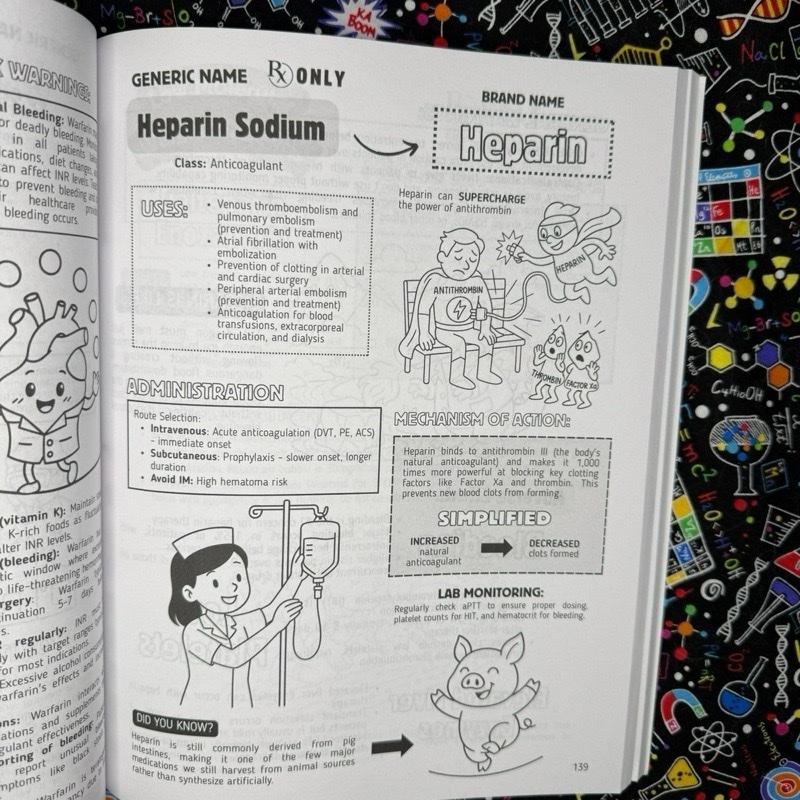
Top 200 Drugs Simplified rebuilds pharmacology around that truth. Every one of the 200 highest-prescribed drugs gets its own illustrated, colorable spread complete with a memorable mnemonic scene (a Benz car for Benztropine, a glowing crystal for Colchicine, a superhero "supercharging" antithrombin for Heparin), a clinical-grade mechanism of action, a one-line "Simplified" translation, side effects, warnings, and the administration details you'll get tested on.
Frequently Asked Questions
Is this seriously a coloring book, or is it a real study guide?
Is this seriously a coloring book, or is it a real study guide?
Both — and that's the point. The illustrations and coloring elements are the delivery mechanism for hardcore pharmacology content: indications, mechanisms, side effects, contraindications, lab monitoring, and clinical pearls. You're not just coloring; you're encoding information visually, which is proven to outperform passive reading for long-term retention. Think of it as the most disguised flashcard set you'll ever own.
What exams will this actually help me with?
What exams will this actually help me with?
The Top 200 are exactly the drugs you'll be tested on in the NCLEX, NAPLEX, PTCB, USMLE Step 1 & 2, MPJE, and most nursing pharmacology midterms. Because the book leads with the generic name (the way exams do) and reinforces brand-name recognition through pictures, it's built for the way these tests actually ask questions.
I'm not "artistic" at all. Will I still get value from this?
I'm not "artistic" at all. Will I still get value from this?
Yes — and it's a common worry that disappears by page three. The illustrations are already drawn for you; coloring them is a passive, low-stress activity that keeps your hands busy while your eyes absorb the content. There's no "right" way to color a kidney. The point is the time-on-page, not the artwork.
Who is this book actually for?
Who is this book actually for?
Pharmacy students (PharmD), nursing students (ADN, BSN, NP, DNP), medical students (MD, DO), pharmacy technicians (CPhT), and any healthcare professional who wants a refresher on the most commonly prescribed medications. It's also genuinely useful for caregivers and patients trying to understand the drugs in their own medicine cabinet.
How is this different from Memorang, Picmonic, or Sketchy Pharm?
How is this different from Memorang, Picmonic, or Sketchy Pharm?
Those are subscription apps you rent. This is a 300+ page physical book you own forever. There's no login, no recurring fee, and no algorithm deciding what you see next. You flip, you color, you mark it up, you keep it for residency. It also leans harder on clinical pharmacist insight administration tips, lab monitoring, real-world warnings because the author actually fills prescriptions for a living.
How is this different from Memorang, Picmonic, or Sketchy Pharm?
How is this different from Memorang, Picmonic, or Sketchy Pharm?
Those are subscription apps you rent. This is a 300+ page physical book you own forever. There's no login, no recurring fee, and no algorithm deciding what you see next. You flip, you color, you mark it up, you keep it for residency. It also leans harder on clinical pharmacist insight administration tips, lab monitoring, real-world warnings because the author actually fills prescriptions for a living.

Stop Memorizing. Start Recognizing.
The students who score in the top percentile on pharmacology exams aren't the ones who studied the longest. They're the ones who studied the way their brain actually works through patterns, pictures, and association.
Top 200 Drugs Simplified is your shortcut to that group. 300+ pages of illustrated, colorable, PharmD-built content that takes the 200 drugs you absolutely have to know and turns them into images you literally cannot forget. From the cardiovascular blockbusters (lisinopril, metoprolol, atorvastatin) to the high-yield antibiotics, antivirals, anticoagulants, and CNS agents every page is a mini-memory palace waiting to be filled in.
Try it for 30 days. If your recall doesn't sharpen, your confidence doesn't climb, and your exam scores don't move send it back. No fine print.
The Top 200 Drugs, Made Easy to Remember
No endless drug lists. No alphabet-soup mnemonics. Just a powerful visual system that turns the top 200 drugs into images your brain refuses to forget.
-

The mnemonics are weirdly perfect.
I laughed out loud at the "Early Bird Gets the Worm" page for Colchicine. Then I aced that exact question on my pharmacotherapy exam two weeks later. Worth every dollar.
-

Finally, a book that respects my visual brain.
I'm a third-year nursing student and I've spent hundreds on Quizlet subscriptions, flashcards, and apps. This is the first resource that didn't make me feel stupid for needing pictures to learn. I color one drug a night and it just stays.
-

I'm using this to prep for the NAPLEX.
The high-yield review pages on the clotting cascade and RAAS alone were worth the price. I had been confusing factor Xa and factor IIa for a year. One colored page later, fixed.
-

Bought it for myself. Ended up sharing it with my whole study group.
We rotate it like a textbook now. Everyone adds notes in different colored pens. It's become the most marked-up, most-loved book in our cohort.
-

My preceptor noticed.
I started recalling drug mechanisms during rounds without flinching, and my preceptor literally asked what changed. I told her "a coloring book." She ordered one for her kid in nursing school the next day.


